Why Businesses Keep Outsourcing the Same Problem
Category: Tags: Transaction Cost Economics, Outsourcing Strategy, Organisational Judgment
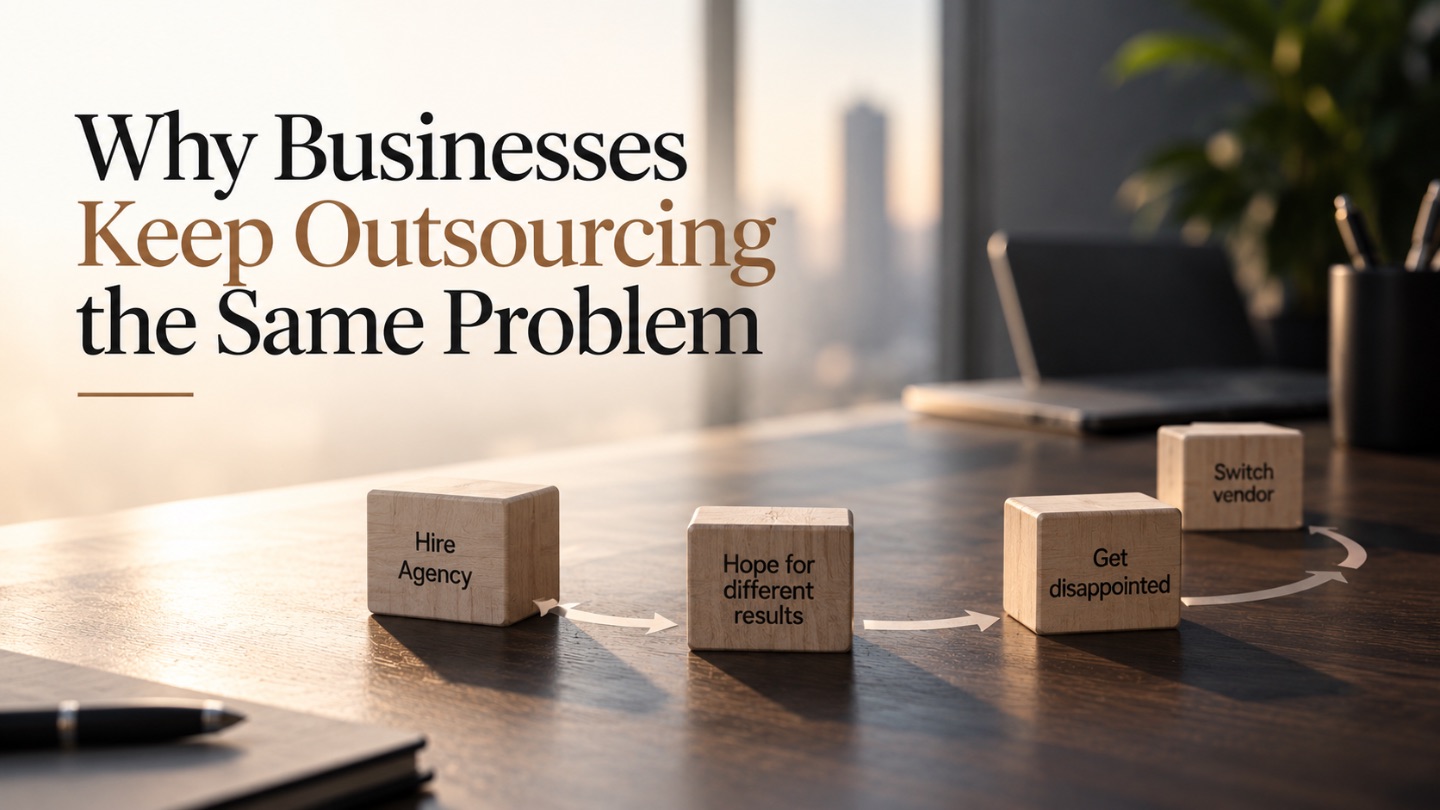
There is a pattern that shows up reliably in businesses that have outsourced the same function two, three, sometimes four times over a decade. The first agency didn't deliver. The second agency delivered but at a cost that never quite made sense. The third agency was better, until the account manager changed, and the quality dropped with them. Each time, the business goes looking for a new vendor, evaluates them carefully, signs the contract, and hopes this one will be different. It rarely is, not because the vendors are interchangeable, but because the business is solving the wrong problem. It keeps trying to find the right vendor for a function it has never actually learned to judge.
Why Firms Exist At All
In 1937, the economist Ronald Coase published a paper that would eventually earn him a Nobel Prize, asking a question that sounds almost too simple to be profound: why do firms exist at all, instead of every task being contracted out on the open market?1 Coase's answer was that using the market has real costs, the cost of finding a supplier, negotiating terms, monitoring quality, resolving disputes, that don't show up on an invoice but are real nonetheless. A firm exists, in his framing, wherever it is cheaper to organise a function internally than to keep paying those costs repeatedly through the market. This sounds like abstract economics until it's applied to the exact pattern above. A business that keeps outsourcing the same function and keeps being disappointed is, in Coase's terms, paying transaction costs it hasn't accounted for, the cost of evaluating vendors it can't fully judge, the cost of monitoring work it doesn't have the internal expertise to assess, the cost of switching every time the relationship sours. Those costs are invisible on the outsourcing invoice. They show up instead as years of mediocre results and a slow accumulation of frustration that gets blamed on the vendors rather than on the decision to outsource the judgment itself.
The Asset That Can't Be Bought Back Easily
The economist Oliver Williamson, extending Coase's work decades later in research that also earned him a Nobel Prize, introduced a concept that explains why some functions are especially prone to this trap.2 Williamson pointed to what he called asset specificity, the degree to which the knowledge or capability required for a task is specific to a particular business's context, versus generic and interchangeable across any buyer. Highly specific knowledge, deep understanding of a particular customer base, a particular brand's voice, a particular market's regulatory quirks, is expensive and slow to build inside a vendor relationship, because the vendor has to relearn it, imperfectly, with every new client, including this one. Functions with high asset specificity are exactly the functions businesses should be most cautious about permanently outsourcing, because the vendor can never fully substitute for judgment that only develops through sustained, specific exposure to that one business. And yet these are often the functions mid-sized businesses outsource first, brand positioning, customer strategy, market-specific go-to-market decisions, precisely because building that judgment internally feels slower and harder than simply buying it in.
What Gets Lost, Not Just What Gets Spent
Gary Pisano and Willy Shih, in a widely cited 2009 Harvard Business Review analysis of American manufacturing competitiveness, documented a related and sobering finding.3 When companies outsourced not just production but the process knowledge behind it, repeatedly, over years, they didn't just lose a cost line. They lost what Pisano and Shih called the industrial commons, the connected ecosystem of skills, judgment, and problem-solving capacity that only exists where the work itself is actually being done. Once that commons erodes, it doesn't come back quickly or cheaply, because rebuilding judgment takes the same slow, experience-based path it took to build the first time. The same erosion happens in mid-sized businesses that have outsourced marketing judgment, sales strategy, or customer experience design for long enough that nobody inside the business can any longer tell good work from mediocre work in that function. At that point, the business isn't choosing between vendors on quality. It is choosing between vendors it has no reliable way to evaluate, which is precisely why the same disappointing cycle repeats with each new one.
Why Switching Vendors Doesn't Fix It
This is the part that trips businesses up repeatedly. When a vendor relationship disappoints, the natural response is to find a better vendor. Sometimes that helps, briefly. But if the underlying issue was never the vendor's competence, it was the business's inability to direct, evaluate, and integrate that function into its own judgment, a new vendor inherits the exact same unstructured relationship the old one had. The clock resets. The pattern doesn't. A vendor, however good, optimises against the brief it is given and the oversight it receives. It cannot supply the judgment the business itself never built about what good actually looks like in that function. That judgment either exists inside the business, at least enough to direct and evaluate the work, or it doesn't, and no amount of vendor switching manufactures it from outside.
What This Actually Requires
Breaking the cycle doesn't necessarily mean bringing every function in-house. Some functions genuinely belong outside, where specialisation and scale make external expertise more efficient than anything a mid-sized business could build alone. The distinction that matters is whether the business has built enough internal judgment to direct that function intelligently, brief it clearly, and evaluate its output honestly, regardless of who is executing it. That judgment is not created by hiring one person to manage the agency. It is created the same way any other capability is built, deliberately, over time, through direct exposure to the work, not just its outputs.
A Question Worth Sitting With
The next time a vendor relationship ends in disappointment, it's worth asking a question that rarely gets asked before the next RFP goes out. Are we looking for a better vendor because this one genuinely underperformed, or because we still don't know, internally, what good would have actually looked like. Most businesses that have outsourced the same function more than once have never answered that question. It is usually the real reason the cycle keeps repeating.
Falgun has worked with founder-led businesses across telecom, hospitality, and premium consumer brands for 28 years. He writes from experience, not observation.
References
- Coase, Ronald H. The Nature of the Firm. Economica, 1937.
- Williamson, Oliver E. The Economic Institutions of Capitalism. Free Press, 1985.
- Pisano, Gary P., and Shih, Willy C. Restoring American Competitiveness. Harvard Business Review, July-August 2009.
Falgun Mistry
Ideation People